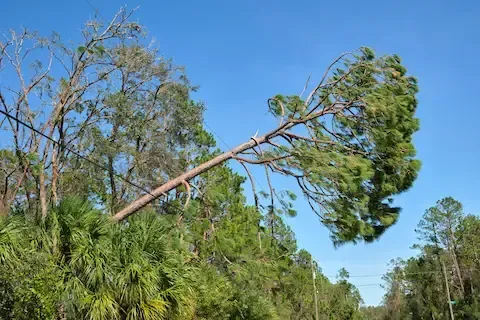
Fall Storm Emergency Tree Response in Mountlake Terrace
Fall in Mountlake Terrace brings more than changing leaves. The combination of saturated ground from early-season rain, residual summer drought stress, and the first serious wind events of the year creates conditions where trees fail without warning. A branch that looked stable in September can become a rooftop hazard by mid-October. Understanding how emergency tree response actually works — from the moment you call to the final debris haul — helps you make faster decisions when time matters most.
Why Fall Storm Season Hits Harder in Mountlake Terrace
The Pacific Northwest transition from dry summer to wet fall happens quickly, and trees in Mountlake Terrace bear the brunt of that shift. Roots that have been working through dry compacted soil suddenly face saturated ground that offers far less anchoring strength. At the same time, trees are still holding full or partial canopy when the first major wind events arrive — typically in October and November — which means significantly more wind resistance than a dormant winter tree would have.
Neighborhoods near McAleer Creek and the low-lying areas along 212th Street SW see this play out regularly. Mature Douglas firs and big-leaf maples that border property lines become liability concerns the moment sustained winds start moving through the area. The issue is not just falling trees — it is trees that lean, that partially uproot, or that drop primary limbs in ways that block driveways, damage fences, or land on structures.
How Emergency Dispatch and Crew Staging Works
When a storm is active or just passed, response timelines depend heavily on call volume across the service area. For Emergency Tree Removal situations, the priority order is straightforward: imminent structural threat first, then utility adjacency, then access blockage, then cleanup and removal of fallen material that poses no immediate danger.
When you call during or after a storm event, expect the dispatcher to ask specific questions. Where is the tree in relation to your home — is it touching the structure, leaning against it, or down in the yard? Is there a power line involved? Can you get out of your driveway? These questions are not bureaucratic — they determine crew assignment and equipment selection before anyone arrives on site.
Crew staging during major storm events typically means teams are pre-positioned in high-call-volume areas rather than dispatching from a central yard. This reduces response time when multiple properties in the same neighborhood are affected simultaneously. If you are in Mountlake Terrace proper, that staging often happens at accessible commercial lots along 244th Street or near the Terrace Creek area, allowing faster deployment to residential streets.
Hazard Tree Triage on Arrival
The first thing a crew does on arrival is not start cutting. It is assess. A tree on the ground is a different problem than a tree that is partially standing, and a tree leaning against a house requires a completely different approach than one that fell into the yard. The initial walkthrough covers load points, secondary failure risk, utility proximity, and what equipment can safely reach the work zone.
Partially uprooted trees are among the most dangerous situations after a fall storm. The root ball is under tension, and the direction of failure if that tension releases is not always predictable. Crews use rigging systems to control removal sequence, often working from the top down to reduce canopy weight before addressing the base. This takes longer than it might look from the street, and that is by design.
Trees that are leaning against a structure require coordination with the homeowner about interior staging — in some cases, clearing the room below before removal begins is a necessary precaution. If a tree has already compromised a roof or exterior wall, the removal plan has to account for the structure's integrity at the contact point.
What Post-Storm Cleanup Actually Involves
Once the immediate hazard is resolved, the remaining scope is cleanup — and that scope varies widely depending on what the storm left behind. A single fallen limb is a few hours of work. A fully uprooted tree across a backyard involves stump grinding, root void filling, and multiple truckloads of debris. Knowing the difference matters when you are getting quotes.
Standard emergency response covers removal of the tree and primary debris to the property line. Chip and haul, stump grinding, and grading of the disturbed soil area are often separate line items. In Mountlake Terrace, street-side debris placement for city pickup depends on the size and volume of material — large root balls and trunk sections typically require private haul, not municipal collection.
If you are dealing with fence or structure damage where the tree came down across a property boundary, the cleanup conversation may involve your neighbor. Crew leaders can walk both parties through what is being removed, what is staying, and who is responsible for which portion. Getting that alignment early avoids disputes during the work.
Preparing Before the Storm Arrives
The most effective emergency response is the one you do not need. Fall is the right time to have trees inspected before major wind events hit. Signs of concern include visible root flare disruption, cracks in the trunk or major scaffold limbs, dead wood that has not been removed from the crown, and any leaning that has become more pronounced since the previous season.
For more context on recognizing when a situation crosses from manageable to urgent, review our emergency response coverage — it walks through the specific indicators that require a same-day call rather than a scheduled appointment.
Trees bordering structures, driveways, and power service lines in Mountlake Terrace deserve attention before October storms arrive. A pre-season inspection is a fraction of the cost of an emergency callout, and it gives you time to plan removal or structural pruning on a schedule you control rather than one the weather sets for you.
After the Crew Leaves
Once the work is complete, document everything. Photograph the removal site, the damage to any structures, and any adjacent property impact before final cleanup. If you are filing a homeowner's insurance claim, your carrier will want documentation of both the tree failure and the response. Crews can provide written service summaries that include the tree species, the failure type, and the work performed — ask for that before the team departs.
Soil disturbance from uprooted trees, particularly larger specimens, can affect drainage patterns on your property. In areas of Mountlake Terrace with clay-heavy soils, that disturbance may need attention before winter rains establish new drainage channels in the wrong places. It is worth having that conversation with the crew before they leave the site.
