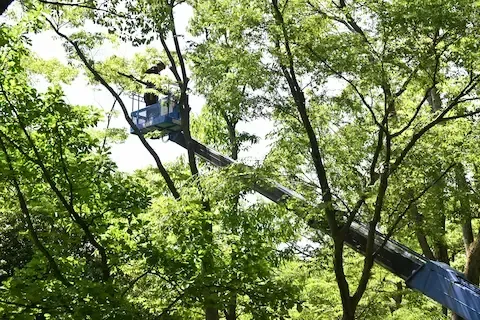
Tight Lot Crane Removal on Mountlake Terrace Streets
Removing a large tree from a small Mountlake Terrace lot is one of the more demanding jobs in residential arboriculture. When a Douglas fir or big-leaf maple has grown taller than the roofline, crowded against a fence line, and sits twenty feet from the property line, conventional removal methods stop working. Crane-assisted removal changes the equation — but it also introduces a new layer of complexity around access, staging, and street use that homeowners need to understand before work begins.
Why Tight Lots Demand a Different Approach
Mountlake Terrace was largely built out during the postwar decades, and the residential streets reflect that era's planning assumptions. Lots tend to be modest, setbacks are tight, and mature trees that were once saplings in the 1960s and 1970s now dominate the available space. When removal becomes necessary — due to storm damage, disease, or root conflicts with foundations — there is often no clear drop zone. A tree cannot simply be felled to the ground if a fence, a garage, a neighbor's roof, or a utility line occupies every direction.
A crane solves this by lifting sectioned pieces vertically out of the canopy and swinging them to a controlled landing zone. But the crane itself needs room to stand. On streets like 232nd Street SW or blocks near Lakeview Drive, that standing room often means the crane occupies a lane of traffic or sits on a residential street for the duration of the operation. That is where planning becomes as important as the removal itself.
Street Access and Permit Requirements
Any crane staging on a public Mountlake Terrace street requires coordination with the city. This typically involves a right-of-way permit, which governs the hours of operation, lane closures, and the placement of traffic control devices. The permitting process is not onerous, but it takes time, and skipping it creates real liability exposure for the homeowner if a vehicle or pedestrian is affected during the operation.
Professional crews working in Mountlake Terrace are familiar with this process. They know which streets have overhead utility conflicts that affect crane height, which blocks have grade changes that affect outrigger placement, and which permit offices handle residential right-of-way requests for Snohomish County jurisdictions. When you hire experienced tree removal professionals, this coordination is typically handled as part of the job scope — not as an afterthought.
Neighbor Notification and Block Logistics
Even when all permits are in order, the practical reality of a crane on a residential block affects more people than just the homeowner. Vehicles parked along the street may need to be moved the night before. Adjacent driveways may be temporarily inaccessible during the lift sequence. Neighbors with lines of sight to the operation need to know what to expect and when to expect it.
Experienced crews in Mountlake Terrace will typically doorhang or personally notify neighbors within a reasonable radius a few days before the job. This is not just courtesy — it prevents the job from being interrupted by a frustrated neighbor blocking the crane path with their car, or a vehicle parked in the landing zone overnight. The more coordinated the block communication, the smoother and faster the actual removal goes.
On narrow streets, the crew may need to establish one-lane alternating traffic control for the duration of the job. Flaggers at either end of the work zone keep traffic moving safely while protecting the crew. This adds to crew size and cost, but it is the correct approach on streets where blocking a full lane would otherwise strand residents.
Staging the Landing Zone
One of the most underappreciated aspects of tight lot crane work is landing zone preparation. The crane operator and the lead arborist in the tree work together to determine where each piece will be set down after it is lifted clear of the canopy. On a standard suburban lot, that landing zone might be the front lawn or the driveway. On a congested Mountlake Terrace block, it might be a section of street, a neighbor's cleared side yard with permission, or a designated area in a nearby cul-de-sac.
The landing zone needs to be clear of people, stable enough to accept heavy log sections without damage, and within the reach arc of the crane. These constraints mean the landing zone has to be chosen before the job starts — not improvised piece by piece as sections come down. Crews doing this work regularly in Mountlake Terrace residential neighborhoods walk the site beforehand, often more than once, to confirm that the plan works in three dimensions before the crane is ever ordered.
Overhead Utility Conflicts
Puget Sound Energy and the local telecom utilities run lines through Mountlake Terrace neighborhoods at heights that can interfere with crane operations. Before any lift begins, the crew identifies whether the boom path crosses any active lines. In some cases, a utility hold or temporary de-energization may be required, which adds scheduling time. In others, the crane approach angle can be adjusted to clear the lines entirely.
This is another reason that site assessment matters so much before the equipment arrives. A crane mobilized to a job that cannot proceed because of an unplanned utility conflict costs money and delays the homeowner. On congested residential blocks in Mountlake Terrace, getting this assessment right the first time is essential.
What Homeowners Should Prepare For
If you are scheduling a tight lot crane removal on your Mountlake Terrace property, there are a few practical things to prepare in advance. Move vehicles out of the driveway and off the street in front of your home the night before. Identify any surface features — irrigation heads, buried lines, decorative planters — in the landing zone and let the crew know before work starts. Keep children and pets well away from the work area for the full duration of the job, not just during the main lifts.
You should also plan for a full day of work even on medium-sized trees. Tight lot logistics, utility clearances, and traffic control slow the pace compared to open yard removal. That additional time is the cost of doing the job correctly in a confined environment.
For homeowners who want to understand the full scope of what crane removal involves before committing to a project, reading more on crane tree removal provides useful context on the method, equipment, and decision criteria that apply to Mountlake Terrace residential sites.
Getting the Job Done Right
Tight lot crane removal in Mountlake Terrace is a solvable problem when the right crew, the right equipment, and the right planning come together. The streets are narrow, the lots are small, and the trees are often large — but those conditions exist throughout this community and experienced crews have developed reliable systems for handling them. The key for homeowners is choosing a team that treats the planning phase with the same seriousness as the removal itself.
