Signs Your Bigleaf Maple Needs Mountlake Terrace Help
Bigleaf Maples in Mountlake Terrace show clear warning signs when they need professional attention. Look for included bark at branch unions, co-dominant stems that have begun splitting, fungal conks or bracket fungi growing from the trunk, and sudden late-summer leaf drop before fall color develops. Bark damage that exposes white or orange wood, weeping sap with a sour smell, and crown dieback progressing inward from branch tips are also serious indicators. These signs point to structural failure risk, decay, or disease that a certified arborist should evaluate before the tree becomes a hazard to your property or neighbors.
What Does Included Bark Mean for a Bigleaf Maple?
Included bark forms when two stems or a branch and trunk grow at a narrow angle, trapping bark tissue between them instead of forming a strong wood union. In Bigleaf Maples, which naturally develop broad spreading crowns with multiple leaders, this is one of the most common structural defects you will encounter. The embedded bark prevents the joint from ever bonding properly, creating a built-in crack that widens under load. Wind, snow accumulation on the wide maple leaves, and the sheer weight of large lateral branches all apply force directly to that weak seam. If you see a tight V-shaped crotch with a visible dark line running down into the wood, that union is a candidate for failure. A certified arborist can assess whether cabling, reduction pruning, or removal of one stem is the appropriate response before the split becomes catastrophic.
Why Do Bigleaf Maples Drop Leaves Early in Summer?
Sudden leaf drop in July or August — weeks before normal fall color — is one of the clearest distress signals a Bigleaf Maple can send. In the Mountlake Terrace area, this often points to one of several underlying causes. Armillaria root rot, also called honey fungus, attacks the root system and vascular tissue, cutting off water and nutrient flow so the crown shuts down early. Verticillium wilt is a soil-borne fungal pathogen that blocks the sapwood, causing individual branches or whole sections of the crown to wilt and drop leaves mid-season. Drought stress during dry Pacific Northwest summers can trigger early drop as a survival response, though healthy root systems on established trees usually buffer this well. Early leaf drop combined with crown thinning, branch dieback, or visible fungal growth below the tree is a cluster of symptoms that warrants a professional Tree Health Assessment rather than a wait-and-see approach.
What Do Fungal Bodies on the Trunk Indicate?
Bracket fungi, conks, or shelf mushrooms growing directly from the bark or root flare of a Bigleaf Maple are not cosmetic issues. They are the fruiting bodies of wood-decay fungi that have been working through the internal tissue for months or years before becoming visible. Common species affecting maples in this region include Ganoderma and Laetiporus — the latter often called chicken-of-the-woods. By the time a conk appears, the column of decay inside the tree is already substantial. The tree may look healthy from the outside with full foliage and intact bark, but the structural wood supporting it is compromised. This is why visual crown inspection alone is not sufficient. A trained arborist will probe, sound the trunk, and use their knowledge of decay patterns to estimate how much sound wood remains. Trees near structures, driveways, or public areas in Mountlake Terrace neighborhoods deserve prompt evaluation when fungal bodies appear.
How Serious Is Bark Damage or Weeping Sap?
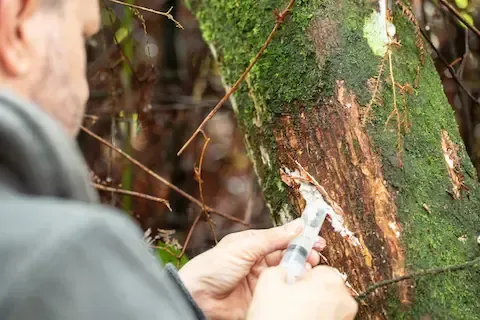
Bark damage on a Bigleaf Maple can result from mechanical injury — mower strikes, vehicle contact, construction equipment working too close to the root zone — or from biological causes like borers or bacterial infection. Exposed wood that has turned orange or white beneath the bark indicates active decay or a serious wound response. Weeping sap with a sour or fermented smell, sometimes accompanied by dark staining on the bark, is a symptom of bacterial wetwood or slime flux. While wetwood rarely kills a tree directly, it signals internal water-logging and bacterial colonization that weakens structural wood over time. Any bark wound that encircles more than a third of the trunk's circumference — called girdling — is a critical concern because it interrupts the flow of nutrients from the canopy to the roots. If you notice these symptoms, reviewing our diagnostic assessment notes can help you understand what a full tree risk evaluation covers before you schedule a visit.
When Should You Call an Arborist in Mountlake Terrace?
Not every maple symptom requires emergency action, but several combinations warrant a call rather than a wait. Contact a certified arborist if your Bigleaf Maple shows any of the following: co-dominant stems with visible cracking at the union, crown dieback affecting more than twenty percent of the canopy, fungal bodies at the base or on the trunk, roots that have heaved or appear to be decaying at the soil line, or a lean that has developed or increased noticeably over one season. Mountlake Terrace properties often have mature Bigleaf Maples that have been growing for fifty years or more. These trees have significant value — shade, habitat, aesthetic character — but their size also means failure events are high-consequence. An early assessment almost always costs less than emergency removal after a failure, and in many cases the tree can be preserved with targeted intervention when problems are caught before they advance.
