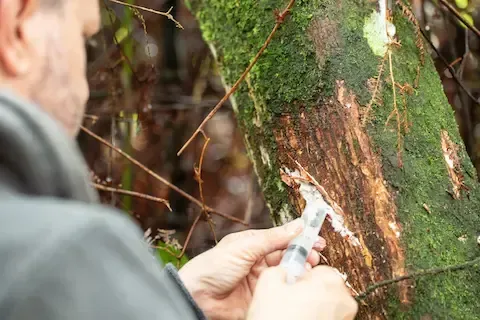
Douglas Fir Risk Evaluation in Mountlake Terrace WA
Douglas firs are among the most common large trees on residential properties throughout Mountlake Terrace, and they carry a presence that defines many neighborhoods in this part of Snohomish County. But size and longevity don't equal safety. A mature Douglas fir can look entirely healthy from the street while harboring internal decay, compromised root structure, or structural defects that make it genuinely dangerous during a Pacific Northwest windstorm. Understanding how to evaluate risk in these trees — and when to act — is one of the more important things a homeowner in this area can learn.
Why Douglas Fir Risk Evaluation Is Different from Other Species
Douglas firs grow large, sometimes reaching heights of 150 feet or more, and they're deeply rooted in the ecology of western Washington. That scale is part of what makes risk evaluation more consequential. A large Douglas fir failure doesn't mean a broken branch over a flowerbed — it often means a multi-ton stem coming down on a roof, fence, or power line.
What makes firs specifically challenging is that they're prone to certain failure types that aren't always visible. Root rot caused by Phellinus weirii or Armillaria species can progress for years before surface signs appear. Co-dominant stems create structural weaknesses that only become obvious under wind or snow load. And the species tends to retain its foliage even when significantly stressed, meaning visible decline can lag well behind actual danger.
Storm Exposure and Site Conditions in Mountlake Terrace
Mountlake Terrace sits in a position that channels weather from multiple directions. Storms coming down from the north and northwest — common during late fall and winter — hit properties on elevated terrain with particular force. If your Douglas fir grows on a slope, a ridgeline, or in a yard where neighboring trees have recently been removed, its wind exposure has likely increased significantly.
Companion tree removal is one of the most overlooked risk factors in this area. When a stand of firs grows close together, they've developed root systems and trunk taper adapted to that specific wind environment. Remove one or two trees, and the remaining trees are suddenly exposed to loads they weren't structurally prepared to handle. If that describes your property, any remaining Douglas firs deserve a closer look — not just a casual inspection, but a structured evaluation that includes both above-ground structure and below-ground conditions.
Reading the Signs: What to Look for in a Douglas Fir
A risk evaluation doesn't require specialized equipment to begin. Homeowners can gather meaningful information just by walking around the tree carefully and observing a few key indicators.
Bark condition near the base: Cracking, discoloration, or fungal conks at the root collar are significant warning signs. Look for bracket fungi or mushrooms emerging from the base or from exposed roots.
Lean and direction of lean: Some lean is natural, but a lean that has increased noticeably or points toward a structure is a concern. Compare it to reference points like fence lines or building corners if you've watched the tree for years.
Crown dieback: Dead branches in the upper crown, clusters of brown needles, or sparse foliage on one side of the tree can indicate root dysfunction, disease, or vascular disruption.
Co-dominant stems: If the tree has two or more main stems of roughly equal diameter originating from a single attachment point, the included bark between those stems creates a weak union. This is a common failure point in Douglas firs during windstorms.
Exposed roots or soil mounding: Roots lifting from the soil on the opposite side of a lean can indicate that the root plate is beginning to shift.
None of these signs in isolation tells the full story, but any combination of two or more warrants a professional evaluation. For a deeper understanding of how a formal evaluation is structured and what it covers, more on tree health checks walks through the process in detail.
Root Health and the Limits of Visual Inspection
The most dangerous failures in Douglas firs often involve the root system, which is precisely the part of the tree that's hardest to assess without tools. Root rot can hollow out the structural base of a tree while leaving the crown looking perfectly normal. In Mountlake Terrace, where many large firs grow on clay-heavy soils that stay saturated through long wet seasons, root rot pathogens find particularly favorable conditions.
Soil compaction from construction, utility installation, or even years of foot traffic can cut off oxygen to feeder roots and weaken the overall anchorage system. Properties near major road corridors or where utilities have been trenched close to large firs are worth flagging for this reason.
Advanced diagnostics — including resistograph drilling, which measures wood density without significantly damaging the tree, or ground-penetrating radar for root mapping — can reveal what surface inspection cannot. These aren't standard for every evaluation, but they're appropriate when the tree is large, the target below it is significant, and visual signs are ambiguous. Firs are one species among many on a typical lot. Our tree health assessment guide for Mountlake Terrace homeowners covers what a whole-property review looks at and what it costs.
Co-Dominant Stems and Structural Failure Risk
Co-dominant stems deserve their own section because they're one of the most common structural problems in Douglas firs and one of the most frequently underestimated. When two stems compete for dominance from an early age, they grow upward side by side with a seam of compressed, inward-growing bark between them — called included bark. This creates a structurally weak attachment point that can fail suddenly under dynamic load, meaning wind, ice, or even the tree's own weight during drought stress.
In Mountlake Terrace, co-dominant stems are especially common in Douglas firs that were never structurally pruned when young — which describes the vast majority of residential firs in the area. If you have a fir with a visible V-shaped fork in the main stem below 30 or 40 feet, that union should be part of any professional evaluation. Cabling and bracing can provide supplemental support in some cases; removal of one stem may be appropriate in others.
When to Act: Matching Response to Risk Level
Risk evaluation leads to one of several outcomes: no action needed, monitoring, mitigation, or removal. Not every Douglas fir with a defect needs to come down. Many trees with minor co-dominant stems, modest lean, or small bark wounds can be managed safely with periodic inspection, targeted pruning, or structural support.
The decision framework involves two variables: the likelihood of failure and the consequences if failure occurs. A fir with moderate internal decay growing in an open field poses a very different risk than the same tree growing 20 feet from a bedroom window. Consequence of failure — what's in the target zone — matters as much as the structural condition of the tree itself.
When you're weighing those variables for a large fir on your Mountlake Terrace property, a qualified arborist can assign a structured risk rating and give you defensible documentation of what was found and what was recommended. A Tree Health Assessment provides exactly that — a systematic review of the tree's condition relative to its specific site and surroundings.
Making Informed Decisions About Douglas Firs on Your Property
Douglas firs are worth preserving where possible. They provide significant wildlife habitat, stormwater interception, energy savings through shading, and real property value. The goal of risk evaluation isn't to create reasons to remove trees — it's to understand what each tree actually presents so that decisions are informed rather than reactive.
Mountlake Terrace homeowners who invest in a structured evaluation before storm season are in a fundamentally different position than those who wait for something to happen. You gain documentation, clarity, and — in most cases — confirmation that your firs are doing exactly what they're supposed to do. When they're not, you know early enough to do something about it on your own terms.
